

Thomas French Fine Art



Lucy Lee-Robbins (1865-1943)
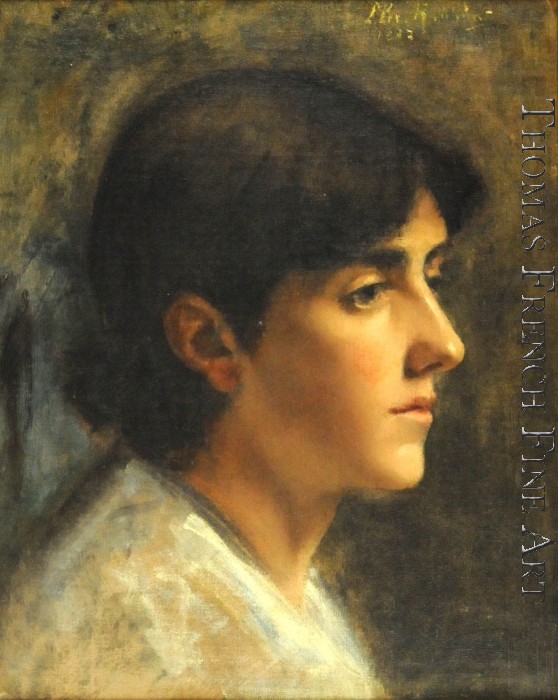
Early in my art dealing career, I purchased this wonderful academic painting from the late Eric G. Carlson (1940-2016). Eric had found the painting in New York. Being an expert in French Art, Eric immediately recognized the signature on the painting to be that of Lucy Lee-Robbins (1865-1943), an American ex-patriot unknown in America, but somewhat famous in France. Eric knew the Carolus-Duran portrait of Lucy then hanging in the Chrysler Museum (now in the National Portrait Gallery) and her career at the Paris Salon. Lucy had made her debut at the Salon in 1887 where she was awarded a prize.
The Unconventional Woman Artist
The scholarship on Lucy Lee-Robbins is limited. Ms. Brandon Brame Fortune, currently Chief Curator at the National Portrait Gallery, wrote an excellent article on Lucy published in American Art, University of Chicago Press. In the article, Ms. Fortune details a life of a most unconventional female painter from a wealthy family, challenged by follow artists for her relationship with the famous painter/teacher Carolus-Duran. Many assumed that her artistic accomplishment was due to her relationship with Duran. There exists a snarky letter from fellow American artist Cecilia Beaux being critical of Lucy for being the “massier” or manager of Duran’s classes.
Fortune sums up the controversy succinctly. “The word “protegee”, like “star pupil” was part of a coded, gendered language used to attack Lee-Robbins. This sort of language permitted discussions of Lee-Robbins’s painting during the years before her marriage, when her single-and expatriate-status, combined with her position as Carolus-Duran’s most favored pupil, placed her precariously outside the boundaries of proper haut-bourgeois female existence.” (page 50)
“…while Sargent was praised for creating work that was similar to that of Carolus-Duran, Lee-Robbins received criticism for the same reason.” (page 51)
Lucy created many striking large, exhibition size paintings of female nudes. Ms. Fortune sums up what today we would correctly scream as sexism and discrimination:
“…Lee Robbins’s singular position as the young, wealthy, unmarried, favored pupil of a notorious French artist, and as a strong-willed woman who painted large-scale female nudes, could not be assimilated within the American codes of conventional behavior. Although the French could appreciate her lifestyle and her painting, in the eyes of the American colony she had compromised her success as an artist and jeopardized her social position.” (page 60)
The painting
When Eric found the painting, he started researching how the painting came to America. Most of Lucy’s paintings were created in France, exhibited in France and reside in France. Eric found a reference to a painting by Lucy exhibited at the National Academy of Design in the Fall of 1887, Portrait of a Lady, No. 424 in the catalog. Later, I found that it hung in the West Gallery along with works by Francis Murphy, Carroll Beckwith, Homer Dodge Martin, Jasper Cropsey and Leonard Ochtman. The owner of the NAD painting is listed as J. J. Robbins (Lucy’s brother). Although we cannot prove the provenance of the painting, our painting is dated 1887 below the signature. It was found in New York. Is it coincidence or is our painting, the painting exhibited at the National Academy of Design in 1887? No one will ever know for sure.
Lucy Lee-Robbins (1865–1943)
Lucy Lee-Robbins was an American expatriate painter whose distinguished career unfolded primarily in Paris during the late nineteenth and early twentieth centuries. Born in New York on June 24, 1865, she relocated to France with her family while still young and pursued her artistic education in Paris. She studied under Carolus-Duran and Jean-Jacques Henner, two of the leading academic painters of the period, and emerged as one of the most accomplished American women artists working abroad during the Belle Époque.
Lee-Robbins first exhibited at the Paris Salon of the Société des Artistes Français in 1887 and subsequently became a regular participant in the leading French exhibitions of her day. In 1890 she achieved a notable distinction when she became the first woman elected as an associate member of the Société Nationale des Beaux-Arts, reflecting the esteem she enjoyed within the Parisian art establishment. Her work was also exhibited at the National Academy of Design, the Pennsylvania Academy of the Fine Arts, the Art Institute of Chicago, and the World's Columbian Exposition in Chicago in 1893.
Working primarily as a figure painter, Lee-Robbins became known for ambitious compositions that combined academic draftsmanship with psychological sensitivity. Her paintings frequently centered on female subjects, which she portrayed with a degree of independence and intellectual presence uncommon in the academic art of the period. Her greatest success came with Les Trois Parques (The Three Fates), exhibited at the Salon of 1891 and subsequently purchased by the French government for the Musée du Luxembourg. This acquisition represented a remarkable achievement for an American woman artist and established her reputation on an international level.
In 1895 she married the painter Hendrik-George van Rinkhuyzen and remained in Paris for the remainder of her life. Although much of her oeuvre was dispersed and numerous works have been lost, particularly during the upheavals of the twentieth century, surviving examples attest to the high regard in which her work was held by contemporary critics and institutions.
Museum holdings associated with Lee-Robbins include the preparatory drawing for Les Trois Parques, preserved in the Department of Graphic Arts of the Louvre, and the celebrated 1884 portrait of the artist by Carolus-Duran in the collection of the Chrysler Museum of Art. Additional works and archival materials are preserved in French and American collections, although many paintings remain unlocated.
Today Lee-Robbins is increasingly recognized as an important figure among the generation of American women artists who established professional careers in Paris before 1900. Her success in the French Salon system and her election to the Société Nationale des Beaux-Arts represented significant milestones for women artists of her era, helping to expand opportunities for subsequent generations of American women working on the international stage.
Excellent
INQUIRIES
Please provide your name & email address and we will contact you about this product when its most convenient for you. Provide your phone number in the optional comments area for a more immediate response.
All form fields are required.